Ranked roughly by complexity. All doable with current inventory.
Last updated: 2026-03-31
1. Atari Punk Console on Steroids — MODULAR BUILD
Four separate modules, each in its own enclosure. Patchable via 3.5mm jacks. Each module runs on 9V battery OR 12V barrel jack (dual power via Schottky diode isolation — two 1N5817 per module). Barrel jack path goes through a 7809 regulator if using 12V PSU (skip if using 9V PSU). Unplug the barrel → battery takes over automatically.
1a. Clock Module
Status: Not started
Difficulty: Easy
A universal clock source. Sends a pulse at a regular rate. This drives 1b, but can drive anything that needs a clock.
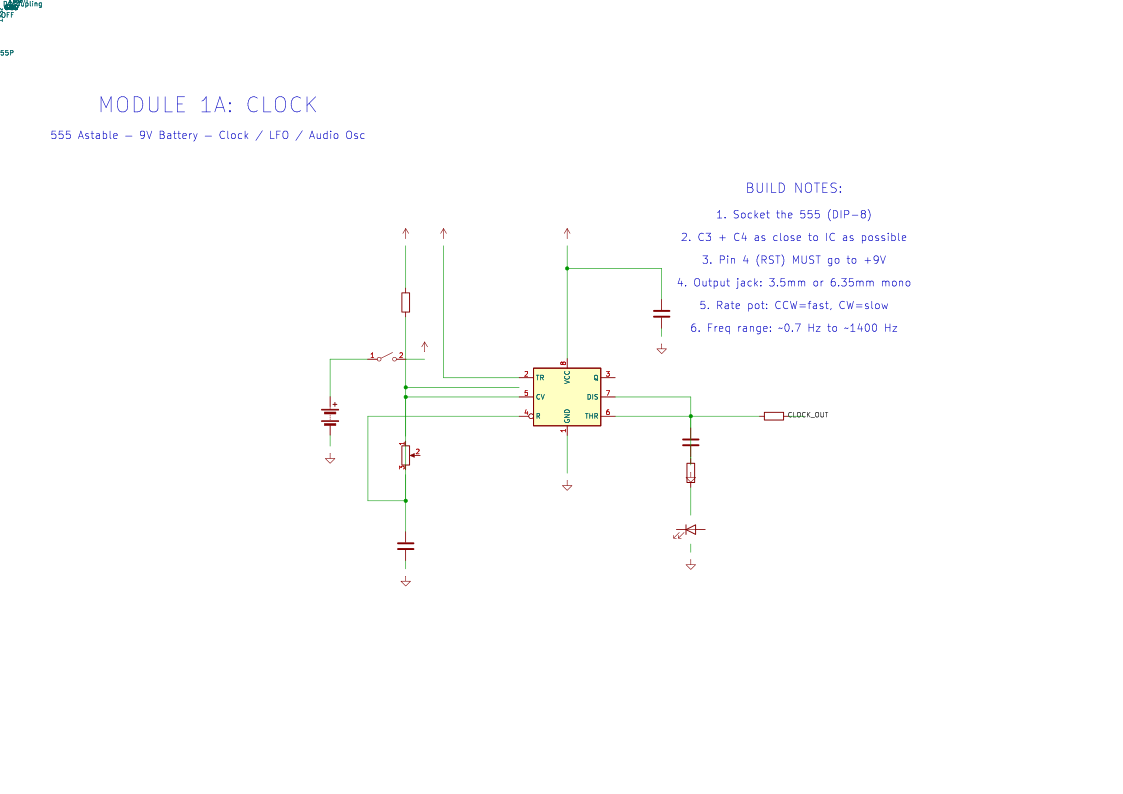
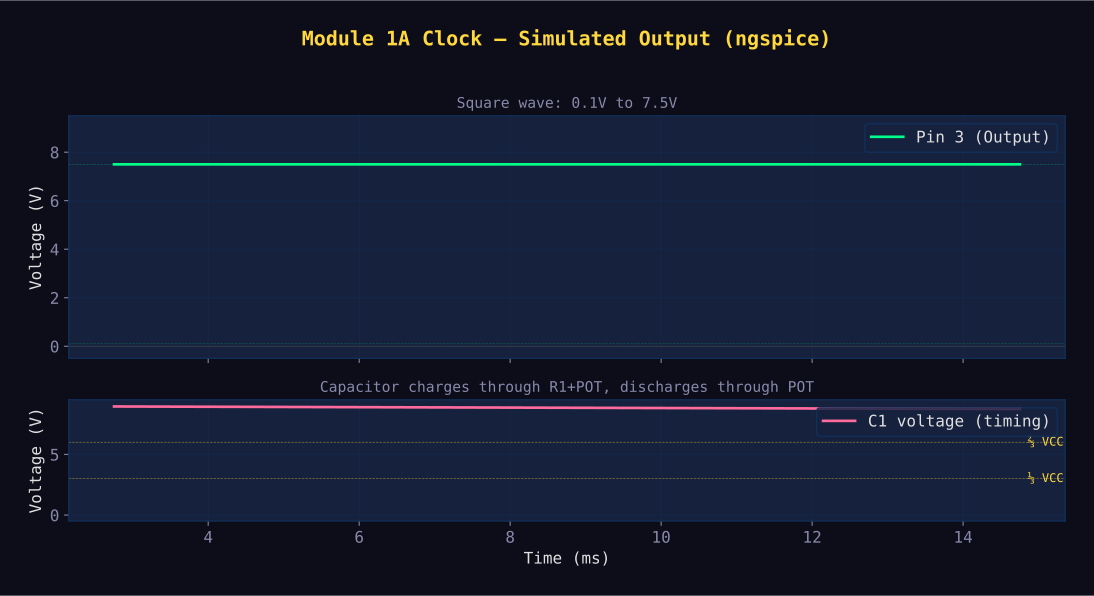
What it does: Generates a steady pulse. Rate knob controls speed (slow sweep to audio rate). LED blinks on each pulse. Output via 3.5mm jack.
Circuit:
555 or CD4093 (one gate) as astable oscillator
B100K or B1M pot for rate (speed)
LED + resistor on the output as pulse indicator
3.5mm mono output jack (clock out)
Controls:
Rate pot
Tap tempo button (optional — momentary switch manually fires a clock pulse)
Clock LED
Power:
9V battery snap + 1N5817 diode
2.1mm barrel jack + 1N5817 diode (+ 7809 if 12V PSU)
SPDT on-off-on switch: battery / off / barrel
Parts from inventory:
1x 555 or CD4093
1x B100K or B1M pot
1x LED, 1x momentary switch
1x 3.5mm jack, 1x barrel jack, 1x battery snap
2x 1N5817, 1x 7809 (if 12V), 1x SPDT on-off-on
IC socket, caps, resistors, stripboard
1b. Step Counter Module
Status: Not started
Difficulty: Easy
A universal step counter. Receives a clock pulse, advances through steps, lights up LEDs. Sends step selection signals to 1c (or anything that needs to know which step is active).
What it does: Counts incoming clock pulses and cycles through 8 (or 4/6/10) steps. Each step lights an LED. Outputs the active step signal.
Circuit:
CD4017 decade counter
Clock input via 3.5mm jack (from 1a or any clock source)
8x LEDs + resistors (one per step)
Reset button (momentary — returns to step 1)
Step count selector (wire unused CD4017 outputs back to reset pin — rotary switch or jumper to select 4/6/8/10 steps)
8-pin output header or ribbon to 1c (active step lines)
Optional: 3.5mm gate/trigger output jack per step (for future use)
A universal CV source. The active step from 1b selects which pot's voltage to send out. The output is just a voltage — it can control pitch on the APC, filter cutoff, LFO rate, or anything that accepts CV.
What it does: 8 pots, each set to a different voltage. Whichever step is active in 1b, that pot's voltage appears at the output jack.
Circuit:
CD4051 8-channel analog multiplexer (the active step from 1b's CD4017 selects which pot is routed to the output — this needs the 3 address lines decoded from the 4017's 8 outputs, OR wire each 4017 output through diodes to the 4051 address pins)
8x B100K pots (one per step — each sets a voltage via a voltage divider from the power rail)
Output level pot (B100K attenuator — scales the CV range to suit whatever you're driving)
3.5mm output jack (CV out)
Input from 1b via 8-pin header/ribbon (step selection lines)
Alternative (simpler, no 4051 needed):
Wire each CD4017 output (from 1b) through a diode + pot to a shared output bus. The active step's pot voltage appears on the bus. This is how most simple Lunetta sequencers do it — fewer parts, slightly less clean signal, but works great.
Controls:
8x pitch pots (one per step)
Output level pot (attenuator)
Power:
Same dual power circuit as 1a
Parts from inventory:
1x CD4051 (mux version) or 8x 1N4148 diodes (simple version)
Your standard Atari Punk Console, but with a CV input jack so the sequencer (or anything) can control pitch externally. Manual pitch pot still works when nothing is plugged in.
What it does: Classic dual-555/556 APC sound. Pitch controlled by either the front panel knob (standalone) or an external CV signal (patched in from 1c or any CV source).
Circuit:
Dual 556 (or 2x 555) — standard APC circuit
B500K pitch pot (manual control)
3.5mm input jack with normalled switching — the jack has a switch contact that disconnects the pot when a cable is plugged in, and reconnects it when unplugged. Most PJ301M-style jacks have this built in (tip + switch + sleeve = 3 pins)
Optional: mix both CV and pot (use a summing resistor network instead of normalled switching — then the pot becomes a fine-tune offset on top of the sequencer CV)
B100K tone pot (standard APC second 555 control)
A100K volume pot (log taper — output level)
3.5mm or 6.35mm output jack
Optional: LM386 + small speaker for standalone use
Controls:
Pitch pot (manual, disconnected when CV patched in)
Tone pot
Volume pot
Power switch (SPDT on-off-on: battery / off / barrel)
[1a Clock] ──3.5mm──► [1b Counter] ──ribbon──► [1c Pitch CV] ──3.5mm──► [1d APC]
   rate pot              step LEDs              8 pitch pots              sound out
                         reset button           level pot
Unplug any cable and each module still works standalone or with something else. The clock can drive a different counter. The CV can drive a filter. The APC works with its manual knob. That's the whole point.
Router PSU setup: 12V router plug → barrel jack → 7809 → 9V rail. Daisy-chain the barrel jacks between modules, or build a small power distribution board with one barrel jack in and 4 barrel jacks out.
2. Lunetta Noise Box
Status: Not started
Difficulty: Easy–Medium
A Lunetta is a CMOS logic synth — no precision components needed, everything is digital and weird. Your CD4093 is actually better than the 40106 for this because the NAND input gives you free gating.
What it is: Multiple 4093 oscillators cross-modulating each other through 4066 switches, with a 4017 sequencer stepping through combinations. Controlled chaos.
Filter — TL074 Sallen-Key LPF with cutoff + resonance pots
LFO — 4th gate of a CD4093 at sub-audio rate → modulates filter cutoff or tremolo via CD4066
Output — TL074 mixer → stereo jack (or LM386 for speaker)
Parts from inventory: Everything needed is in stock.
Reference: Full verified schematic with pin numbers in session 6d803568 — resume with claude --resume 6d803568-3adc-4327-8ed9-5cebc45312b7
4. Arduino CV Sequencer
Status: Not started
Difficulty: Medium
Use the Uno as the brain of a proper sequencer with screen, MIDI out, and analog CV.
What it is: Arduino reads pot positions, outputs stepped voltages to control your analog oscillators' pitch. Add MIDI output to control soft synths or external gear.
Parts from inventory:
Arduino Uno R3
8x pots (analog inputs)
Momentary switches (step, mode, reset)
LEDs (step indicators)
Needs (wishlist):
MCP4725 or MCP4922 DAC module (~€3) for proper CV output
MIDI DIN socket + optocoupler (6N138) for MIDI out
5. Drone Machine
Status: Not started
Difficulty: Easy
No sequencer, no rhythm — just layered oscillators you tune and detune against each other for evolving textures. Meditative, ambient, Sunn O)))-adjacent.
What it is: 4–6 oscillators (mix of 4093 and 555), each with pitch pot and on/off switch, mixed through a TL074, optional filter.
Parts from inventory:
2x CD4093 (4 oscillators)
2x 555 (2 more oscillators with different character)
1x TL074 (mixer + optional filter)
6x pots, 6x latch switches, LEDs
Stripboard
6. Toy Circuit Bending
Status: Ongoing (keeping toys for parts)
Difficulty: Easy — no schematic, just exploration
Not a build — a method. Take a battery-powered toy that makes sound, open it up, probe connections with a wire while it's running, and find the points that make it glitch. Add switches, pots, and jacks to those points.
What to look for in toys:
Battery powered (safe voltages)
Makes sound (has a speaker and a sound chip)
Interesting sounds or speech
Cheap / already broken
Parts from inventory: Momentary switches, pots, jacks, wire, soldering gear
7. PT2399 Delay/Echo
Status: Not started
Difficulty: Easy–Medium
Lo-fi tape-style delay. One PT2399 + a handful of passives = complete echo circuit.
Faithful reconstruction of Jessica Rylan's Flower Electronics Little Boy Blue. No original schematic exists — this is reverse-engineered from the published architecture and discrete transistor synth principles.
What it is: 2 ramp/sawtooth VCOs with voltage-controlled waveshaping, envelope follower with inverter, 2-channel mixer, and diode bridge VCA output stage. The diode bridge is the secret weapon — it cross-modulates everything into gnarly, unpredictable harmonics. All discrete transistors, banana jack patching, dual 9V battery power (±9V).
Parts from inventory: 2N3904 x12, 2N3906 x2, 1N4148 x6, all resistors, all caps, pots, switches — all in stock
Needs (to buy):
4mm banana jack sockets x20 (panel mount, assorted colours)
4mm banana plugs x20+ (for patch cables)
DPST toggle switch x1 (power)
PP3 battery snaps x2
Enclosure (wood if honouring Jessica's fir, or Hammond box)
Full design doc:schematics/lbb-clone-design.md
9. Theremin Module (CD74HC4046AE)
Status: Not started
Difficulty: Medium
Heterodyne theremin using the CD74HC4046AE PLL's built-in VCO. Hand proximity to antenna changes capacitance, shifting frequency. A second fixed oscillator provides the reference — the beat frequency between them is the audible output.
Architecture:
Variable oscillator — CD74HC4046AE VCO, frequency set by antenna capacitance + trimmer cap
Fixed reference oscillator — second CD74HC4046AE or 555, tuned to nearby frequency
Mixer/heterodyne — diode ring or single transistor, extracts the audible difference frequency
Low-pass filter — RC filter to clean the audio output
Output buffer — single transistor or TL072 stage → 3.5mm jack
Antenna: ~30cm copper rod or telescopic radio antenna (charity shop radio). Mounted on panel, insulated from ground.
Controls:
Coarse tune trimmer (set once during calibration)
Fine tune pot (front panel)
Volume pot
Antenna
Parts from inventory:
1x CD74HC4046AE (VCO + PLL)
1x 555 or second 4046 (reference oscillator)
1x TL074 or TL072 (output buffer)
Diodes (1N4148 for mixer), pots, resistors, caps
Needs (to buy):
Small trimmer capacitors (5-60pF) — for tuning
Low-value ceramic caps (10pF, 22pF, 47pF, 100pF)
Antenna (telescopic or copper rod)
10. DollaTek PAM8610 Amp Stage
Status: Have the board — ready to use
Difficulty: None — it's pre-built
PAM8610 Class-D stereo amp, 10W+10W into 4-8Ω speakers at 12V. Has 3.5mm input, volume pot, and power socket already on board. Use as the final output stage for the whole modular system.
Hookup:
1f Mixer output → 3.5mm cable → DollaTek board → speakers
12V barrel jack PSU → DollaTek power input
Needs: Just speakers (4-8Ω, any size) and a 12V PSU (same one powering the modules).
    9V POWER RAIL (see power section below)
        |
        |
   [R1 1KΩ]              Protection resistor — stops short
        |                  circuit when pot is at minimum
        |
        +-------- PIN 8 (VCC)
        |         PIN 4 (RESET) ---- tied to PIN 8
        |
        +-------- PIN 7 (DISCHARGE)
        |
 [RATE POT B1M]          Full CCW = fast, Full CW = slow
   (wiper to             (reverse the outer lugs if you
    pin 7,                want it the other way)
    one lug to
    pins 2/6,
    other lug
    unused)
        |
        +-------- PIN 6 (THRESHOLD) --+-- PIN 2 (TRIGGER)
        |                              |
   [C1 1µF]              Timing cap — sets the base range
        |                  (film or electrolytic, observe
        |                   polarity if electrolytic:
        |                   + to pins 2/6, - to GND)
        |
       GND


    PIN 3 (OUTPUT) ----+----[R2 1KΩ]----+---- OUTPUT JACK TIP
                       |                |
                  [R3 1KΩ]         [C2 10µF]    DC blocking cap
                       |                |        (optional — only
                      LED              GND       needed if receiving
                       |                         module doesn't want
                      GND                        DC offset)

    PIN 5 (CONTROL) ---[C3 100nF]--- GND    Noise filter (always include)

    PIN 1 (GND) ------- GND
Use passive multiples (jacks wired in parallel, no circuit) to split the clock to multiple destinations
1b receives the clock, advances through steps, lights LEDs, sends the active step to 1c
1c outputs a voltage (set by the step's pot) to 1d's CV input
1d makes sound, controlled by the CV. Its audio output goes to 1f
1e makes noise independently. Optionally receives the clock for gated bursts. Audio out to 1f
1f mixes everything to a final output
Any cable can be unplugged and each module still works standalone. That's the whole point.
Passive Multiples (Clock Splitter)
No circuit needed. Just wire 3.5mm jacks in parallel:
TIP  ──┬── TIP  ──┬── TIP  ──┬── TIP
       │          │          │
SLEEVE─┴── SLEEVE─┴── SLEEVE─┴── SLEEVE
One input jack, 3+ output jacks. Solder tip-to-tip, sleeve-to-sleeve. Mount in a small box or a strip on the side of a module. Works for clock, CV, audio — anything.
Module 1a: Clock
What it does: Generates a steady pulse. Rate knob controls speed. LED blinks. Output via 3.5mm jack.
Core connections (diode-OR method — simplest, no 4051 needed):
+9V ──── each pot top leg
GND ──── each pot bottom leg

From 1b:
  Step output Q0 ── 1N4148 diode (anode) ──┐
  Step output Q1 ── 1N4148 diode (anode) ──┤
  Step output Q2 ── 1N4148 diode (anode) ──┤
  ...                                       ├── CV BUS
  Step output Q7 ── 1N4148 diode (anode) ──┘
                                            │
  Each diode cathode ── pot wiper ──────────┘

CV BUS ── Output level pot (B100K) ── 3.5mm jack tip (CV OUT)
                                      3.5mm jack sleeve ── GND
How it works: When a CD4017 output goes HIGH, it forward-biases that step's diode, passing that pot's wiper voltage to the shared CV bus. All other diodes are reverse-biased (their CD4017 outputs are LOW). The output level pot attenuates the CV range.
Parts: 8x B100K pots (pitch per step), 1x B100K pot (output level), 8x 1N4148 diodes, 1x 3.5mm output jack
Note: Eddy Bergman's build guide combines 1b and 1c on one board. You can do the same or separate them — the ribbon cable between them is just 8 signal wires + ground.
Module 1d: APC with CV Input
What it does: Classic Atari Punk Console sound. Pitch controlled by front panel knob OR external CV from 1c.
Tip: Try different transistors for Q1 — every transistor has a different breakdown voltage and noise character. MPSA18, BC547, BC182L, 2N3904 all work. The "best" one is whichever sounds gnarliest.
Module 1f: Mixer
What it does: Combines audio from multiple modules (1d, 1e, anything else) into one output.
Expansion: Want more inputs? Just add more 100KΩ resistors and jacks to the summing point. Four inputs is fine. Six is pushing it — signal gets quieter with more inputs on a single transistor. For more than 4, consider a TL074 opamp inverting mixer instead.
Power (same for every module)
9V Battery ──┐
              ├── via Schottky diodes (1N5817) ── +9V rail
Barrel jack ─┘   (whichever source has higher voltage wins)

If using 12V PSU: barrel path goes through 7809 regulator first.
If using 9V PSU: skip the 7809, diode only.

SPDT on-off-on switch: Battery / OFF / Barrel

Every module: 100µF electrolytic + 100nF ceramic across +9V and GND.
Daisy-chain barrel jacks between modules, or build a small power distribution board.
Interconnect Summary
From
To
Cable
Signal
1a Clock Out
Passive mult in
3.5mm patch
Clock pulse (0–9V square)
Passive mult out
1b Clock In
3.5mm patch
Clock pulse
Passive mult out
1e Clock In
3.5mm patch
Clock pulse (for gated noise)
1b Step Outputs
1c Step Inputs
8-wire ribbon + GND
Digital HIGH/LOW per step
1c CV Out
1d CV In
3.5mm patch
0–9V DC (pitch voltage)
1d Audio Out
1f Input 1
3.5mm patch
Audio
1e Noise Out
1f Input 2
3.5mm patch
Audio
1e Gated Out
1f Input 3
3.5mm patch
Audio (percussive bursts)
1f Output
Amp/speaker/recorder
3.5mm or 6.35mm
Mixed audio
The only non-3.5mm connection is 1b→1c (ribbon cable with 8 signal wires + ground). Everything else is standard patch cables.
Replaces per-module 9V batteries with a shared power bus.
Created: 2026-04-03
Overview
A simple linear regulated PSU that provides +12V and -12V rails from a single AC or DC wall wart. Each module taps the bus via a power header. The 7812 and 7912 regulators handle voltage regulation and short-circuit protection.
Why +-12V?
Eurorack standard — all schematics online assume +-12V
Op-amps (TL072, TL074, LM13700) sound better on dual supply than single 9V
Gives 24V peak-to-peak signal swing instead of 9V
Compatible with future eurorack modules if you go that route
Can derive +5V for logic (CD4000 series, Arduino) with a 7805 off the +12V rail
Circuit
Input Options (pick one)
Option A — DC wall wart (simplest):
Use a 15V-18V DC wall wart (centre-positive, 1A minimum)
Feed positive side to 7812, negative side to 7912 via a centre-tapped virtual ground
Option B — AC wall wart (classic):
Use a 15V-0-15V AC (centre-tapped) transformer/wall wart
Full-wave rectify each half: +ve rail through 7812, -ve rail through 7912
Cleaner result, but centre-tapped AC adapters are harder to find
Recommended: Option A with a cheap 18V DC wall wart. You'll use the bridge rectifier + voltage doubler/splitter to create the dual rails.
Schematic — DC Input with Rail Splitter
                                    +12V RAIL
                                       |
DC IN (15-18V)                    ┌────┴────┐
    o──────┬──[D1]──┬──[C1]──┬───┤ 7812    ├──┬──[C3]──┬──[C5]──o +12V OUT
    |      |        |  470uF |   │ IN  OUT │  | 10uF   | 100nF
    |   [FUSE]      |        |   └────┬────┘  |        |
    |    1A         |        |        |GND    |        |
    |      |     [D2,D3      |        |        |        |
    |      |      D4,D5]     |     ┌──┴──┐    |        |
    |      |   (bridge)      |     │ GND │    |        |
    |      |        |        |     │ BUS │────┼────────┼──o GND OUT
    |      |        |        |     └──┬──┘    |        |
    o──────┘──[D6]──┘──[C2]──┘───┤ 7912    ├──┴──[C4]──┴──[C6]──o -12V OUT
                        470uF    │ IN  OUT │    10uF     100nF
                                 └────┬────┘
                                      |
                                   -12V RAIL
Simplified approach — use the TLE2426 virtual ground IC or a simple resistive splitter:
Practical Build — Resistive Rail Splitter
This is the simplest approach that actually works well for synth current levels (<500mA total):
DC IN 18V ──[FUSE 1A]──┬──[C_in 470uF]──┐
                        |                  |
                     (+) rail           (-) rail
                        |                  |
                   ┌────┴────┐        ┌────┴────┐
                   │  7812   │        │  7912   │
                   │ I   O   │        │ I   O   │
                   └────┬────┘        └────┬────┘
                        |    GND           |    GND
                   [C3 10uF]  |       [C4 10uF]  |
                   [C5 100nF] |       [C6 100nF] |
                        |     |            |     |
                        o     o            o     o
                      +12V   GND         -12V   GND
Actual recommended circuit:
                    D1 (1N4001)
18V DC IN (+) ──────►|────┬────────── to 7812 IN
                          |
                     C1 (1000uF 25V)
                          |
                         GND ◄──── this is the CENTRE TAP / virtual ground
                          |
                     C2 (1000uF 25V)
                          |
18V DC IN (-) ──────►|────┘────────── to 7912 IN
                    D2 (1N4001)


7812:                           7912:
  IN ──[C3 10uF]── GND           IN ──[C4 10uF]── GND
  OUT ──[C5 100nF]── GND         OUT ──[C6 100nF]── GND
  OUT ──[C7 10uF]── GND          OUT ──[C8 10uF]── GND
       |                               |
     +12V                            -12V
IMPORTANT: This circuit needs a centre-tapped AC adapter (15-0-15 VAC) or a dual-output DC supply. A single-output DC wall wart WON'T give you both rails without a charge pump or inverter.
Simplest Practical Build
For your setup, the easiest approach is:
Option 1: Two separate wall warts (dead simple, no rail splitter needed)
Wall wart 1: 15V DC ──► 7812 ──► +12V rail
Wall wart 2: 15V DC ──► 7912 ──► -12V rail (wire in reverse)
Common GND between them
Option 2: Single 24V DC wall wart + virtual ground (recommended)
24V DC wall wart
       |
       ├── +24V ──[7812 IN]──► +12V
       |           |
       |          GND ◄── Virtual ground (TLE2426 or 2x 10K + op-amp buffer)
       |           |
       └── GND ──[7912 IN]──► -12V (7912 sees -24V relative to virtual GND)
Option 3: AC adapter + bridge rectifier (proper, cleanest)
Use a 15-0-15 VAC (centre-tapped) transformer. Each half gets rectified:
A centre-tapped 15VAC transformer is the proper way. But if you can't find one easily:
Cheapest quick win: Use a 15V DC wall wart for +12V (via 7812) and run your CMOS on single supply for now. Add the -12V rail later when you start building op-amp based modules that need dual supply.
Your current modules (1a-1f) are mostly CMOS logic — they run fine on single +9V or +12V supply. The -12V rail becomes important when you build proper VCFs (LM13700), VCAs, and precision CV circuits.
Parts List
All on the Tayda order:
Part
Qty
From Tayda
7812 voltage regulator
1
Already on order
7912 voltage regulator
1
Already on order
7805 (for +5V logic rail)
1
Already on order
1N4001 rectifier diodes
4
Already in inventory (25x)
1000uF 25V electrolytic
2
Check Tayda — or use 2x 470uF in parallel
10uF electrolytic
4
Already on order
100nF ceramic
4
Already on order
DC barrel jack 2.1mm
1
Already on order
Fuse holder + 1A fuse
1
Not on Tayda — get from AliExpress
LED (power indicator)
1
Already on order
1K resistor (LED limiting)
1
Already on order
Heat sinking
The 7812 and 7912 will get warm. If your input voltage is 18V and you're drawing 300mA:
Power dissipated = (18V - 12V) x 0.3A = 1.8W per regulator
A small TO-220 heatsink (~10C/W) will keep them under 50C
Search Tayda/AliExpress for TO-220 heatsink
Power Bus
Run the +12V, GND, and -12V as three wires (or a ribbon cable) between modules. Each module gets a 3-pin header:
Module power header:
  +12V ──o
   GND ──o
  -12V ──o
Standard eurorack uses a 10-pin or 16-pin IDC header, but for your DIY setup a simple 3-pin header or screw terminal is fine.
Add a 100nF ceramic cap right at each module's power input (between +12V and GND, and between -12V and GND) for local decoupling. This is already standard practice.
Future: +5V Rail
If you need +5V for Arduino/logic:
+12V ──[7805]──► +5V
         |
        GND
The 7805 drops 7V at whatever current your logic draws. At 100mA that's only 0.7W — no heatsink needed. The 78L05 (100mA version, also on order) is fine for pure CMOS logic.
Designed for Andre's DIY modular synth. See WISHLIST.md for parts ordering.
Little Boy Blue Clone — Circuit Design
Reconstruction of Jessica Rylan's Flower Electronics Little Boy Blue.
Designed from known architecture + discrete transistor synth principles.
No original schematic exists — this is a faithful recreation of the topology.
Architecture
The LBB is built from 5 functional blocks, all discrete transistors (no ICs), running on 2x 9V batteries (±9V supply).
Banana jacks at every connection point. Normalized (default internal wiring) but patchable — plugging in a banana cable overrides the internal connection.
Block 1: VCO (x2 identical)
Topology: Constant-current ramp oscillator with transistor reset.
This is the classic discrete sawtooth core used in early Buchla and Serge designs. A PNP transistor acts as a voltage-controlled current source, charging a timing capacitor linearly. When the voltage reaches a threshold, an NPN transistor fires and rapidly discharges the cap, creating a sawtooth/ramp wave.
Circuit Description
Current source (Q1 — 2N3906 PNP):
Emitter to +9V via R1 (1KΩ)
Base voltage sets charging current → controls pitch
Collector charges C1 (100nF timing cap) through R2 (10KΩ)
Pitch CV input (banana jack) + manual pitch pot (B1M) both feed the base via summing resistors
Threshold detector + reset (Q2, Q3 — 2N3904 NPN):
Q2 base watches the capacitor voltage
When cap voltage exceeds ~5V (set by voltage divider R3/R4), Q2 turns on
Q2 collector pulls Q3 base high
Q3 saturates, shorting C1 to ground through a small resistor (R5, 100Ω) — fast discharge = sharp reset
Creates the flyback edge of the sawtooth
Waveshaping (Q4 — 2N3904 NPN):
Emitter follower buffer on the cap voltage
Manual waveshape pot + CV input controls how much of the waveform is clipped
At one extreme: full ramp/sawtooth
At the other: approaches a triangle or pulse-ish shape
This is the "voltage control of oscillator wave shapes" from the LBB spec
Component values per VCO:
Part
Value
Type
Notes
Q1
2N3906
PNP
Current source — pitch
Q2
2N3904
NPN
Threshold comparator
Q3
2N3904
NPN
Discharge switch
Q4
2N3904
NPN
Output buffer + waveshaper
C1
100nF
Film
Timing cap — determines range
R1
1KΩ
1/4W
Emitter resistor
R2
10KΩ
1/4W
Collector load
R3
47KΩ
1/4W
Threshold divider top
R4
33KΩ
1/4W
Threshold divider bottom
R5
100Ω
1/4W
Discharge speed
R6
100KΩ
1/4W
CV summing resistor
R7
100KΩ
1/4W
Pitch pot series resistor
R8
10KΩ
1/4W
Waveshape CV summing
POT1
B1M
16mm linear
Pitch (manual)
POT2
B100K
16mm linear
Waveshape (manual)
Transistors per VCO: 4 (1x PNP, 3x NPN)
Transistors for 2 VCOs: 8
Banana Jacks per VCO (x2)
PITCH CV IN
WAVESHAPE CV IN
RAMP OUT
Block 2: External Input + Envelope Follower
Topology: Amplifier stage with variable gain, followed by precision rectifier and smoothing.
Input preamp (Q5 — 2N3904 NPN):
Common-emitter amplifier
1/4" input jack (the LBB uses 1/4" for external audio in)
Gain pot (A100K log) in feedback path
R9 (10KΩ) emitter resistor, R10 (100KΩ) collector
Envelope follower (Q6, Q7 — 2N3904 NPN):
Q6: emitter follower to buffer the amplified signal
Rectification via D1, D2 (1N4148) — half-wave rectifier
Smoothing: R11 (47KΩ) + C2 (10µF electrolytic)
Attack/release set by these R-C values
Q7: inverting stage (common-emitter) with switch to select normal or inverted envelope
Component values:
Part
Value
Type
Notes
Q5
2N3904
NPN
Input preamp
Q6
2N3904
NPN
Envelope buffer
Q7
2N3904
NPN
Envelope inverter
D1, D2
1N4148
Signal
Half-wave rectifier
C2
10µF
Electrolytic
Envelope smoothing
C3
100nF
Film
Input coupling
R9
10KΩ
1/4W
Emitter resistor
R10
100KΩ
1/4W
Collector load
R11
47KΩ
1/4W
Envelope smoothing
R12
10KΩ
1/4W
Inverter emitter
R13
47KΩ
1/4W
Inverter collector
POT3
A100K
16mm log
Input gain
SW1
SPDT on-on
Toggle
Normal/inverted envelope
J_IN
6.35mm
Mono jack
External audio input
Transistors: 3 (all NPN)
Banana Jacks
ENV OUT (normal/inverted per switch)
Block 3: 2-Channel Mixer
Topology: Simple transistor summing mixer.
Circuit (Q8 — 2N3904 NPN):
Two inputs (VCO 1, VCO 2) via level pots (B100K)
Summed through resistors (R14, R15 — 100KΩ each) into Q8 base
Common-emitter amplifier with R16 (10KΩ) emitter, R17 (47KΩ) collector
Topology: Four-diode ring modulator / balanced modulator.
This is the secret sauce. Jessica Rylan specifically noted that the diode bridge VCA creates "a very special intermodulation." It's a passive circuit — the diode ring modulates the audio signal with the control signal (envelope), creating sum-and-difference frequencies. When driven hard, it cross-modulates everything into gnarly, unpredictable harmonics.
The diode bridge (D3–D6 — 1N4148):
Four 1N4148 diodes in a ring/bridge configuration
Audio input (from mixer) feeds one diagonal
Control voltage (envelope follower) feeds the other diagonal
Output taken from the junction
Output buffer (Q9, Q10 — 2N3904 NPN):
Q9: emitter follower buffer
Q10: output amplifier with volume pot
Drives 1/4" output jack at line level
Part
Value
Type
Notes
Q9
2N3904
NPN
Output buffer
Q10
2N3904
NPN
Output amplifier
D3–D6
1N4148
Signal
Diode bridge ring
R18
10KΩ
1/4W
Bridge bias
R19
10KΩ
1/4W
Bridge bias
R20
4.7KΩ
1/4W
Output emitter
R21
47KΩ
1/4W
Output collector
C4
10µF
Electrolytic
Output coupling
POT6
A100K
16mm log
Output volume
J_OUT
6.35mm
Mono jack
Main output
Transistors: 2
Banana Jacks
VCA AUDIO IN (normalled from mixer)
VCA CV IN (normalled from envelope follower)
VCA OUT
Block 5: Power Supply
2x 9V PP3 batteries → ±9V split supply
Part
Value
Notes
BAT1
9V PP3
Positive rail
BAT2
9V PP3
Negative rail
C5
100µF
Electrolytic, +9V decoupling
C6
100µF
Electrolytic, -9V decoupling
C7, C8
100nF
Ceramic, one per rail near circuits
SW2
DPST
Power on/off (breaks both rails)
The junction of the two batteries = ground (0V).
BAT1 positive terminal = +9V.
BAT2 negative terminal = -9V.
Total Transistor Count: 14
Block
Transistors
VCO 1
4 (1x 2N3906, 3x 2N3904)
VCO 2
4 (1x 2N3906, 3x 2N3904)
Envelope follower
3 (3x 2N3904)
Mixer
1 (1x 2N3904)
Output VCA
2 (2x 2N3904)
Total
14 transistors
(LBB reportedly uses ~20. The extra 6 are likely additional buffering, biasing, and a more sophisticated waveshaping stage. This design captures the core architecture.)
Total Banana Jacks: 9
Jack
Signal
Colour
VCO 1 Pitch CV
Input
Red
VCO 1 Waveshape CV
Input
Orange
VCO 1 Out
Output
Yellow
VCO 2 Pitch CV
Input
Red
VCO 2 Waveshape CV
Input
Orange
VCO 2 Out
Output
Yellow
Envelope Out
Output
Blue
Mix Out
Output
Green
VCA CV In
Input
Blue
Plus normalled (internal) connections:
VCO 1 Out → Mix In 1
VCO 2 Out → Mix In 2
Mix Out → VCA Audio In
Env Out → VCA CV In
Potentiometers: 6
Pot
Value
Function
POT1
B1M linear
VCO 1 Pitch
POT2
B100K linear
VCO 1 Waveshape
POT3
B1M linear
VCO 2 Pitch
POT4
B100K linear
VCO 1 Level (mixer)
POT5
B100K linear
VCO 2 Level (mixer)
POT6
A100K log
Output Volume
POT7
A100K log
Input Gain
What Andre Has vs Needs
HAVE (from inventory):
2N3904 x50 (need 12) ✓
2N3906 x50 (need 2) ✓
1N4148 x100 (need 6) ✓
Resistors (loads) ✓
Capacitors (all sizes) ✓
B1M pots x25 ✓
B100K pots x10 ✓
A100K pots x3 ✓
SPDT on-on switches x5 ✓
6.35mm jacks (some) ✓
Stripboard ✓
Breadboards ✓
NEED TO BUY:
4mm banana jack sockets x9 minimum (get 20 — extras for ground + spares)
4mm banana plugs for patch cables (get 20+ in assorted colours)
DPST toggle switch x1 (for power — breaks both battery rails)
PP3 battery snaps x2 (9V battery connectors with leads)
Enclosure — wood if honouring Jessica's oiled fir, or Hammond box from existing stock